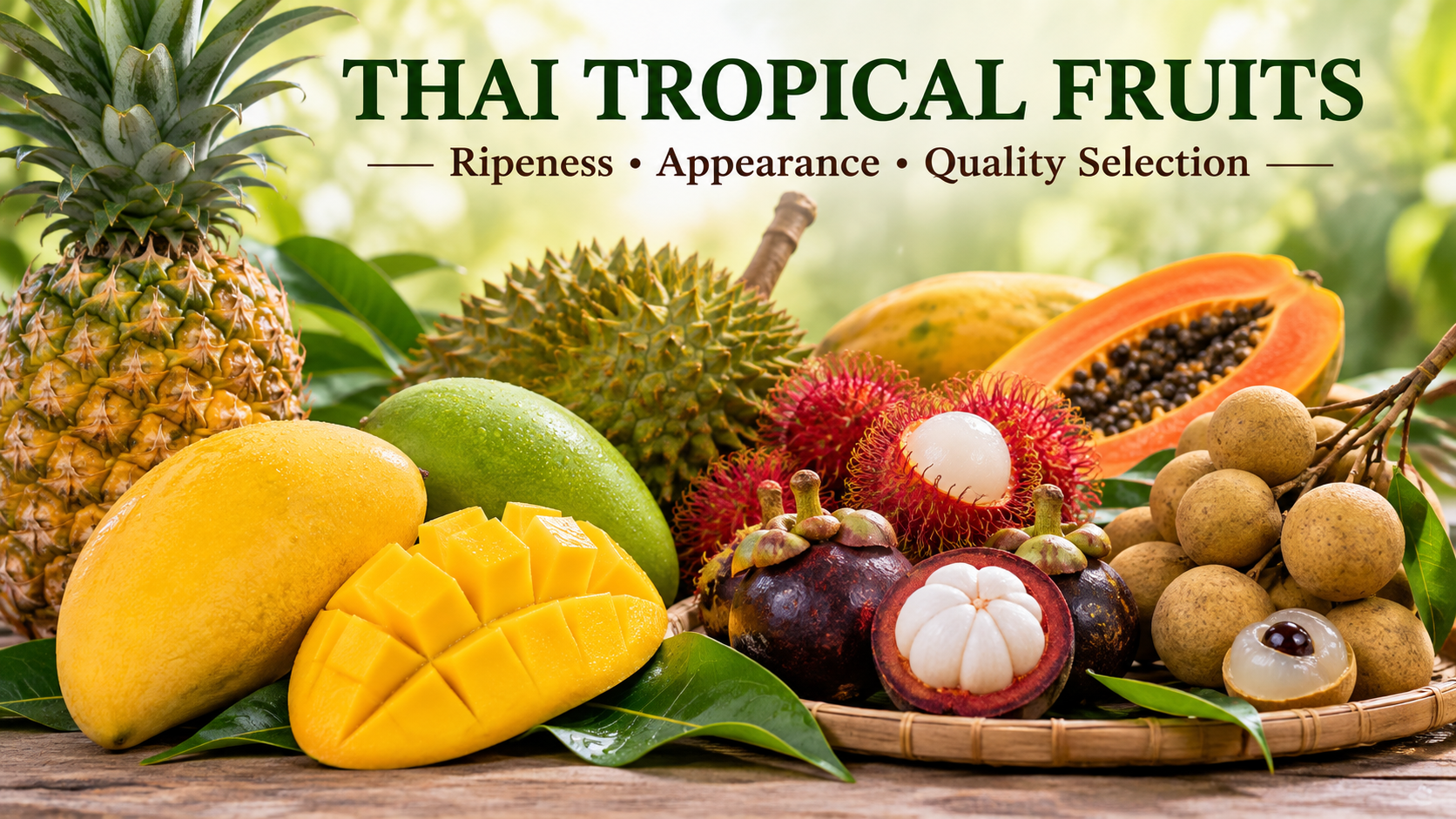
Thai tropical fruits quality is an important consideration for buyers, distributors, retailers, and food businesses seeking fresh produce with suitable flavor, appearance, and shelf-life characteristics.
Thailand offers a diverse range of tropical fruits, including mangoes, durians, mangosteens, rambutans, longans, pineapples, and papayas. Each fruit has distinctive characteristics, and the correct selection depends on variety, ripeness, intended use, and quality requirements.
Understanding these differences can help international buyers make more informed product selections.
Understanding Thai Tropical Fruits Quality and Ripeness
Ripeness is not determined by color alone. Fruit maturity, texture, aroma, sweetness, and external appearance can vary significantly between varieties.
Some tropical fruits continue ripening after harvest, while others must be harvested at an appropriate stage because their eating quality will not improve substantially afterward.
For example, mature mangoes can continue ripening after harvesting. Pineapples, however, should be harvested at a suitable eating maturity because they do not continue to ripen in the same way.
Understanding these characteristics is essential when selecting tropical fruits for different markets and applications.
Popular Thai Tropical Fruits and Their Quality Characteristics
1. Mangoes: Color, Firmness, and Maturity
Thai mangoes are known for their diversity in flavor, aroma, shape, and texture.
Popular varieties include Nam Dok Mai and other varieties suitable for fresh consumption.
Important quality considerations include:
- Variety-specific skin and flesh color
- Uniformity of size and shape
- Appropriate firmness and maturity
- Absence of significant bruising, decay, and insect damage
- Suitable sweetness, aroma, and flesh texture
A green exterior does not necessarily indicate an immature mango because skin color varies among varieties.
The intended use also matters. Mangoes selected for fresh ripe consumption may require different characteristics from those used in salads or food preparation.
2. Durian: Maturity, Aroma, and Flesh Quality
Durian is distinguished by its thorn-covered shell, strong characteristic aroma, and rich flesh texture.
Common Thai varieties include Monthong and Chanee.
Quality evaluation may consider fruit maturity, size, shape, external defects, and the characteristics of the edible flesh.
Depending on the variety, buyers may prefer differences in sweetness, aroma intensity, softness, and flesh consistency.
Durian maturity should be evaluated using appropriate variety-specific indicators rather than relying on shell color alone.
Internal defects and deterioration must also be considered when assessing product quality.
3. Mangosteen: Skin Color and Internal Condition
Mangosteen is recognized for its purple rind and soft white edible segments.
Its external color changes during development and maturation, making rind color an important maturity indicator.
Quality considerations include:
- Appropriate maturity and rind color
- Uniform appearance and suitable size
- Freedom from significant cracks and insect damage
- Acceptable internal flesh condition
- Absence of decay and serious deterioration
External appearance is useful, but it cannot always reveal every internal quality problem.
4. Rambutan: Fresh Appearance and Skin Condition
Rambutan is recognized by its colorful rind covered with soft, hair-like projections.
Its appearance is particularly important for fresh-fruit presentation.
Buyers generally look for suitable skin color, consistent size, minimal damage, and freedom from decay.
Browning of the rind and hair-like projections can result from moisture loss or physical damage.
Careful handling helps preserve the fruit’s appearance and marketability.
5. Longan: Size, Sweetness, and Freshness
Longan has a thin, light-brown shell surrounding translucent white flesh and a dark seed.
Its quality is influenced by maturity, sweetness, size, shell condition, and freshness.
Longans are commonly marketed in clusters. Excessive shell darkening, physical damage, and decay may reduce their visual quality.
Maintaining appropriate storage conditions is important because moisture loss can affect appearance.
6. Pineapple: Maturity, Sweetness, and Appearance
Pineapples are valued for their distinctive balance of sweetness and acidity.
Quality characteristics include suitable maturity, firmness, uniform size, sound flesh, and freedom from serious defects.
A change in shell color can help indicate maturity, but internal quality should also be considered.
Because pineapple does not continue normal ripening after harvest, harvesting at an appropriate maturity is particularly important.
7. Papaya: Flesh Color and Texture
Papaya is another tropical fruit whose characteristics change during ripening.
Depending on the variety, flesh color may develop toward yellow, orange, or red.
Buyers should consider maturity, firmness, external condition, and the intended use.
Papaya selected for ripe fresh consumption may differ from papaya intended for culinary preparation.
Appearance and Quality Selection
Visual inspection is an important first step when assessing Thai tropical fruits quality.
However, attractive appearance alone does not guarantee suitable internal quality.
Important characteristics include overall freshness, uniformity, cleanliness, absence of serious bruising, and freedom from visible decay.
Buyers should evaluate appearance in relation to the specific fruit variety and agreed product specifications.
For additional technical guidance, the UC Davis Postharvest Research and Extension Center provides research-based information about maturity, quality, and postharvest characteristics of individual fruits.
Texture, Aroma, and Flavor Considerations
Different buyers may require different sensory characteristics.
A retailer may prefer fruit with an attractive appearance and sufficient remaining shelf life, while a food-service business may prioritize flavor, ripeness, and immediate usability.
Texture requirements can also vary. Some applications require firm fruit, while others benefit from softer, fully ripe flesh.
Aroma and flavor should be assessed according to the variety and intended application rather than applying identical expectations to every tropical fruit.
Handling and Maintaining Fruit Quality
Tropical fruits are sensitive to various forms of deterioration after harvesting.
Physical damage, moisture loss, unsuitable temperatures, and poor handling can affect freshness and appearance.
Appropriate postharvest handling may include careful sorting, suitable packaging, protection against impacts, and temperature management according to the fruit type.
Different fruits have different storage requirements. Applying one temperature or handling method to all tropical fruits may reduce product quality.
Selecting Thai Tropical Fruits for International Buyers
Before discussing a product sourcing arrangement, buyers should identify the characteristics they require.
These may include fruit variety, preferred maturity, size grade, appearance, intended application, packaging format, quantity, and destination market.
A clear product specification helps buyers and suppliers evaluate whether the proposed fruit matches the intended commercial use.
Availability, grading, supporting documentation, packaging, and destination-specific requirements should be confirmed before any purchase commitment.
Thai Tropical Fruit Sourcing with YA Corporation
YA Corporation Co., Ltd. is a Thailand-based trading and sourcing company with a primary focus on international exports of food and agricultural products.
Fresh fruits are one of the company’s seven product groups, alongside fresh vegetables, nuts and seeds, spices and herb powders, meat products, seafood and aquatic products, and other selected products.
The company focuses on international trading and product sourcing.
YA Corporation can review international buyer inquiries and explore sourcing opportunities according to product specifications, supplier availability, and applicable requirements.
Import-related inquiries may also be considered as the company prepares to expand its business activities.
Contact YA Corporation
International buyers interested in Thai tropical fruits are welcome to submit product inquiries.
Please provide the fruit type, preferred variety, quantity, quality expectations, packaging requirements, and destination country.
YA Corporation Co., Ltd.
Email : yacorporationthailand@gmail.com , info@yacorporationthailand.com
Website: https://yacorporationthailand.com/
All product availability, quality specifications, commercial terms, and regulatory requirements are subject to verification and mutual agreement.
Comments are closed