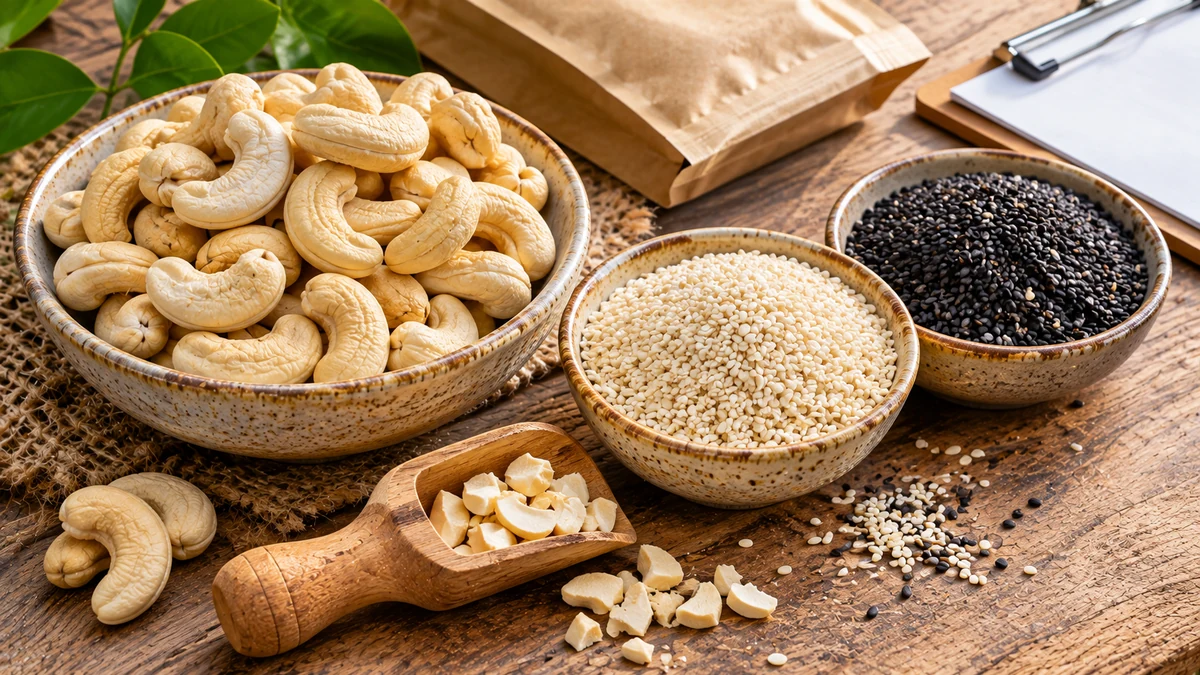
Cashew nuts and sesame seeds are valuable food ingredients used in snack products, bakery applications, confectionery, seasoning blends, and other food formulations.
Although both belong to the broader commercial category of nuts and seeds, they differ in physical characteristics, processing methods, grading considerations, and food applications.
For international importers, distributors, and food manufacturers, understanding these differences can help establish clear product specifications and evaluate suitable sourcing options.
This article explores cashew nuts and sesame seeds, including their quality characteristics, commercial grades, storage requirements, and common culinary applications.
1. Understanding Cashew Nuts and Sesame Seeds
Cashew nuts are obtained from the cashew tree, Anacardium occidentale L.
Commercial cashew kernels are produced through processing that removes the outer shell and associated materials.
Cashew kernels are available in different forms, including whole kernels, splits, and pieces.
Sesame seeds come from Sesamum indicum L., an oilseed crop cultivated in various regions around the world.
Commercial sesame products may include natural, hulled, unhulled, white, black, and other seed varieties.
These distinctions matter because different food applications require different product characteristics.
2. Cashew Nut Quality Characteristics
Cashew kernel quality is commonly evaluated according to appearance, size, shape, color, condition, and the presence of defects.
Whole and Broken Cashew Kernels
Whole cashew kernels generally retain their characteristic shape.
Broken kernels may be classified into splits, butts, or pieces according to the form and extent of breakage.
Both whole and broken kernels can have commercial applications.
The suitable form depends on the intended product.
For example, whole kernels may be preferred for selected snack presentations, while pieces may be appropriate for bakery fillings and food processing.
Color and Appearance
Cashew kernels may vary in color from white or pale ivory to yellowish or brownish shades, depending on their grade and processing history.
Buyers should establish acceptable color characteristics and defect tolerances in their specifications.
Color alone does not confirm the safety or overall quality of a product.
3. Understanding Cashew Nut Grades
Commercial cashew grading involves several criteria, including kernel size, shape, color, and quality classification.
Whole cashew kernels may be described using commercial size designations such as W240, W320, or W450.
These designations generally relate to kernel count per pound within the applicable grading system.
For example, W320 identifies a commercial whole-kernel size category, not a guarantee of superior product quality.
The UNECE Standard DDP-17 for Cashew Kernels provides internationally recognized reference criteria concerning cashew kernel classification and quality.
Buyers should confirm the exact grading standard, acceptable defects, and product specifications with the supplier.
4. Sesame Seed Types and Characteristics
Sesame seeds are available in different colors and processing forms.
White Sesame Seeds
White or light-colored sesame seeds are commonly used in bakery products, confectionery, toppings, and selected food formulations.
Their appearance may vary according to variety and processing.
Black Sesame Seeds
Black sesame seeds are used in selected bakery products, desserts, snacks, and traditional culinary preparations.
Their dark appearance can contribute a distinctive visual characteristic to finished foods.
Hulled and Unhulled Sesame
Hulled sesame has undergone processing to remove the outer seed coat.
Unhulled sesame retains this outer layer.
Hulling can influence appearance, texture, composition, and suitability for particular applications.
Buyers should identify whether they require hulled or unhulled seeds rather than relying only on color descriptions.
5. Sesame Seed Quality Considerations
Sesame seed quality is commonly evaluated through characteristics such as color, purity, moisture, seed condition, and foreign matter.
Different buyers may prioritize different characteristics.
For example, a bakery manufacturer may focus on seed appearance and consistency, while an oil processor may place greater emphasis on oil content.
Important considerations include:
- Seed color and uniformity
- Hulled or unhulled condition
- Moisture content
- Purity and foreign matter
- Damaged or immature seeds
- Relevant microbiological and contaminant requirements
The CBI guidance on sesame seed market requirements discusses quality criteria and the importance of buyer-specific specifications.
Actual requirements vary according to the destination market and intended application.
6. Common Food Applications
Cashew nuts and sesame seeds are used in different types of food products.
Cashew Nut Applications
Cashew kernels may be incorporated into roasted nut snacks, confectionery, bakery products, sauces, and selected processed food formulations.
Whole kernels may be chosen for visual presentation, while broken kernels or pieces can be suitable for certain food manufacturing applications.
Sesame Seed Applications
Sesame seeds are commonly used in bread, buns, crackers, confectionery, seasoning products, and traditional food preparations.
Sesame may also be processed into pastes, oils, or other ingredients, although those processed products have different specifications from whole seeds.
Food manufacturers should evaluate the required ingredient form and performance in their own formulations.
7. Moisture, Storage and Product Condition
Suitable storage is important for maintaining the quality of nuts and seeds.
Moisture exposure can negatively affect product condition and contribute to deterioration.
Cashew kernels and sesame seeds should be stored in appropriate environments and protected from contamination, excessive moisture, and unsuitable temperatures.
Because these products contain natural oils, changes associated with oxidation and rancidity may also affect their flavor and aroma.
Buyers should confirm suitable moisture specifications, supported shelf-life information, and storage conditions with suppliers.
A particular shelf life should not be assumed without product-specific evidence.
8. Food Safety and Allergen Considerations
Quality evaluation should include appropriate food safety considerations.
Depending on the product and destination market, buyers may need to assess microbiological criteria, pesticide residues, relevant contaminants, and product handling practices.
Sesame requires particular attention to microbiological safety, including potential Salmonella contamination.
Allergen identification is also important.
In the United States, tree nuts are classified as major food allergens, and sesame became the ninth major food allergen effective January 1, 2023.
Further information is available from the U.S. Food and Drug Administration.
Buyers should verify the applicable allergen labeling and food safety requirements for their intended markets.
9. Cashew Nut and Sesame Seed Sourcing with YA Corporation
YA Corporation Co., Ltd. is a Thailand-based trading and sourcing company focusing primarily on international exports of food and agricultural products.
Nuts and seeds are one of the company’s seven product groups, alongside fresh fruits, fresh vegetables, spices and herb powders, chilled and frozen meat, fresh and frozen seafood and aquatic products, and other products considered individually.
The company operates as a trading and sourcing company rather than manufacturing the products described in this article.
The company reviews buyer requirements, explores suitable sourcing options, and coordinates product and commercial information.
International exports remain the company’s primary business focus. Suitable import-related inquiries may also be considered according to product requirements and operational readiness.
All product forms, grades, specifications, availability, documentation, and commercial terms require confirmation with the relevant supplier.
10. Contact YA Corporation Co., Ltd.
International importers, distributors, and food manufacturers interested in cashew nuts, sesame seeds, or other nuts and seeds are welcome to submit product inquiries.
Please provide the product name, preferred grade or processing form, estimated quantity, packaging requirements, intended application, and destination country.
Email : yacorporationthailand@gmail.com , info@yacorporationthailand.com
Website: https://yaglobalnuts.com/
Explore Our Nuts and Seeds Website
All product grades, quality specifications, origin information, availability, testing documents, prices, packaging options, and commercial arrangements are subject to supplier confirmation, applicable regulations, and mutual agreement.
Comments are closed