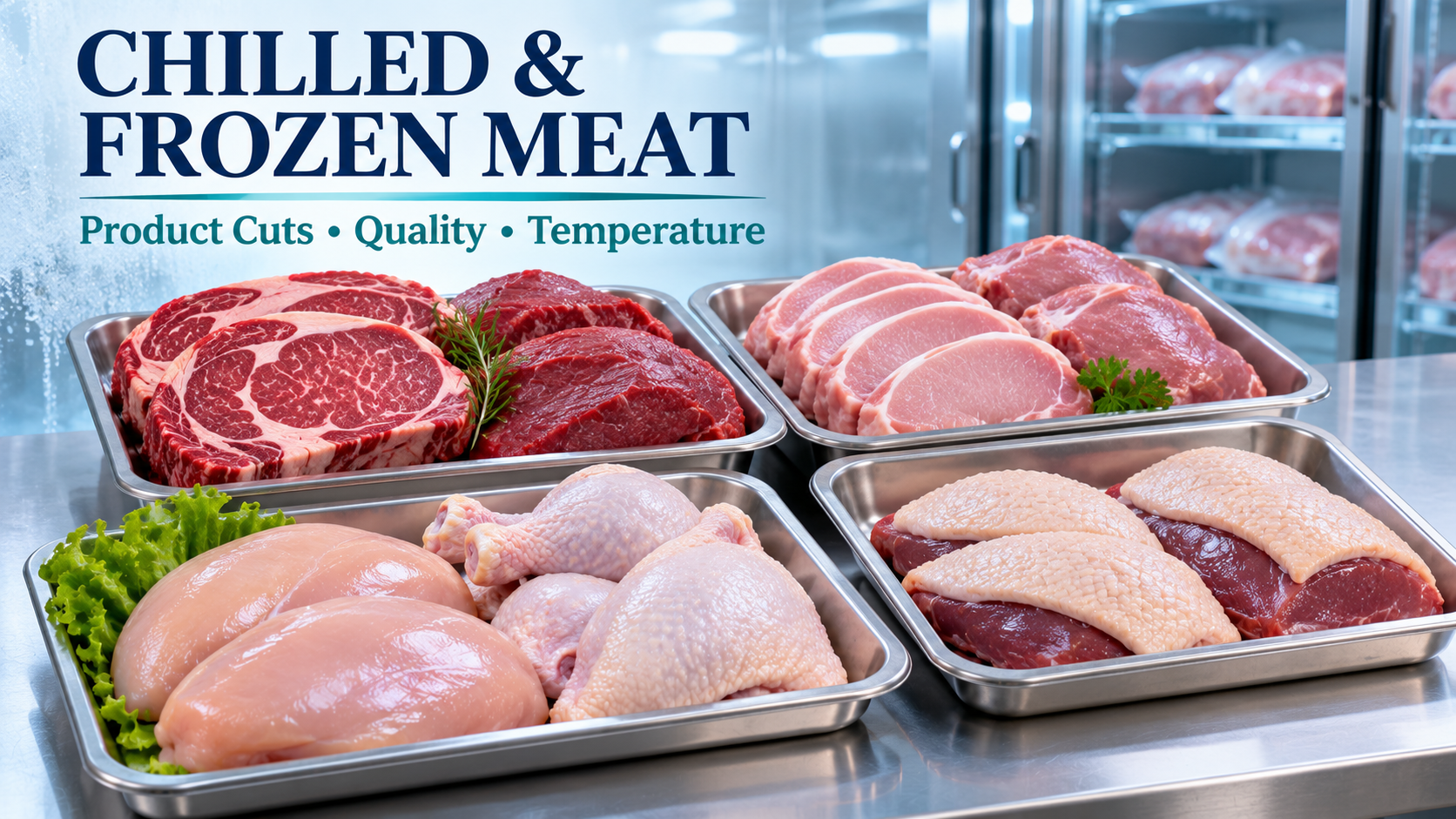
Chilled and frozen meat products are widely used by food manufacturers, distributors, restaurants, retailers, and international buyers. Beef, pork, chicken, and duck can be supplied in different cuts and processing forms, each with specific quality and temperature requirements.
Understanding chilled and frozen meat helps buyers evaluate product characteristics, select suitable cuts, and establish appropriate handling and storage expectations.
Chilled and Frozen Meat: Understanding the Difference
Chilled meat is kept at a controlled low temperature without being intentionally frozen. It generally maintains characteristics associated with fresh meat but has a relatively limited refrigerated shelf life.
Frozen meat is processed and stored at freezing temperatures to support longer-term preservation.
The main differences involve:
- Product condition: Chilled meat remains unfrozen, while frozen meat is held in a frozen state.
- Storage duration: Frozen products can generally be stored longer when correctly handled.
- Texture: Freezing and thawing may influence moisture retention and eating quality.
- Handling: Both products require appropriate temperature control and hygienic practices.
Freezing slows deterioration but does not reliably eliminate harmful microorganisms.
For international purchasing, the chosen product condition should reflect the intended use, distribution arrangements, and applicable quality specifications.
Common Beef, Pork, Chicken and Duck Cuts
Beef Cuts and Product Characteristics
Beef is available in different cuts suited to particular food applications.
Common examples include ribeye, sirloin, tenderloin, brisket, chuck, and round.
Ribeye is known for its marbling, while tenderloin is generally valued for tenderness. Brisket and chuck are commonly selected for applications involving slower cooking.
Buyers may evaluate fat distribution, trimming level, muscle characteristics, bone content, and packaging format.
Cut names and grading systems can differ between countries, so specifications should describe the required product clearly.
Pork Cuts and Quality Considerations
Common pork cuts include loin, belly, shoulder, leg, and ribs.
Pork belly contains alternating layers of fat and lean meat, while loin is generally a leaner cut. Shoulder is commonly selected for food preparation requiring slow cooking or further processing.
Important quality characteristics include fat-to-lean ratio, trimming, cut dimensions, surface condition, and temperature history.
Product selection should match the intended food application and market requirements.
Chicken and Duck Products
Chicken is commonly supplied as whole birds, breast meat, thighs, drumsticks, wings, and other selected portions.
Duck products may include whole duck, breast, legs, and other specified cuts.
Poultry buyers should consider whether the product is bone-in or boneless, skin-on or skinless, whole or portioned, and chilled or frozen.
Product weight ranges, trimming standards, processing methods, and packaging may also influence suitability.
Meat Quality and Inspection Considerations
Meat quality evaluation involves more than appearance.
Buyers may assess color, texture, fat distribution, cut consistency, packaging condition, and product temperature.
Certain color differences can be influenced by the animal species, packaging atmosphere, oxygen exposure, and storage conditions.
Color alone cannot establish food safety.
Likewise, a normal appearance or absence of unusual odor does not guarantee that meat is free from harmful microorganisms.
Product assessments should therefore consider supplier specifications, hygienic processing, relevant testing, and traceability information.
Temperature Control and the Cold Chain
Temperature management is essential for protecting chilled and frozen meat quality.
As a general food-safety reference, the U.S. FoodSafety.gov guidance recommends refrigeration at 4°C (40°F) or below and freezer storage at −18°C (0°F) or below.
These are general reference temperatures rather than universal commercial specifications for every meat product or destination market.
Commercial storage and transport requirements may differ depending on product type, applicable regulations, and buyer agreements.
The cold chain involves maintaining appropriate conditions throughout handling, storage, loading, transportation, and delivery.
Unnecessary temperature fluctuations can affect product quality and may create food safety concerns.
Buyers should confirm applicable temperature limits and monitoring requirements before finalizing product specifications.
For additional guidance, consult the FoodSafety.gov Cold Food Storage Chart.
Freezing, Thawing and Freezer Burn
Freezing is an important preservation method, but the freezing process and subsequent storage conditions can influence meat quality.
Ice crystal formation may affect the structure of meat tissues, particularly when freezing or thawing conditions are unsuitable.
Freezer burn can develop when frozen meat is exposed to air, causing surface dehydration and changes in appearance or texture.
Freezer burn is primarily a quality concern and does not automatically make a product unsafe.
Thawing should follow appropriate food-safety procedures. Refrigerated thawing is generally preferred, while other methods require specific controls.
The FoodSafety.gov food-safety guidance provides useful information about safe refrigeration, freezing, and thawing practices.
Packaging and Product Protection
Packaging protects meat against contamination, moisture loss, and physical damage.
Different products may require vacuum packaging, suitable food-contact bags, sealed cartons, or other approved packaging formats.
Important considerations include package integrity, material suitability, leakage prevention, product identification, and storage compatibility.
Frozen products may also require packaging that limits dehydration during prolonged storage.
Each package should be identified appropriately for the intended product and market.
Lot identification and traceability information can support effective product control throughout the supply chain.
What International Meat Buyers Should Specify
Clear purchasing specifications help reduce misunderstandings.
Before requesting a quotation, buyers should identify:
- Meat type: beef, pork, chicken, or duck.
- Product condition: chilled or frozen.
- Required cuts, trimming, and bone or skin specifications.
- Quantity, weight range, and packaging format.
- Applicable quality, hygiene, and documentation requirements.
- Destination country and required temperature conditions.
The appropriate requirements should be agreed upon before commercial commitments are made.
Meat Sourcing with YA Corporation
YA Corporation Co., Ltd. is a Thailand-based international trading and sourcing company focused primarily on food and agricultural exports.
Chilled and frozen meat is one of the company’s seven product groups, alongside spices and herb powders, fresh fruits, fresh vegetables, nuts and seeds, seafood and aquatic products, and other selected products.
YA Corporation operates as a trading and sourcing company rather than manufacturing meat products itself.
The company welcomes buyer inquiries and can explore potential sourcing arrangements with relevant suppliers.
Product availability, origin, veterinary documentation, quality specifications, permitted trade routes, and regulatory eligibility must be verified before any supply arrangement is confirmed.
YA Corporation is also preparing to develop import activities and welcomes relevant inquiries for consideration.
Contact YA Corporation
International buyers interested in chilled or frozen meat products are welcome to contact YA Corporation to discuss their sourcing requirements.
Please provide the product type, preferred cuts, required quantity, packaging specifications, temperature requirements, and destination country.
YA Corporation Co., Ltd.
Email : yacorporationthailand@gmail.com , info@yacorporationthailand.com
Website: https://yacorporationthailand.com/
All product specifications, availability, pricing, documentation, and commercial arrangements are subject to supplier confirmation, applicable regulations, and mutual agreement.
Comments are closed