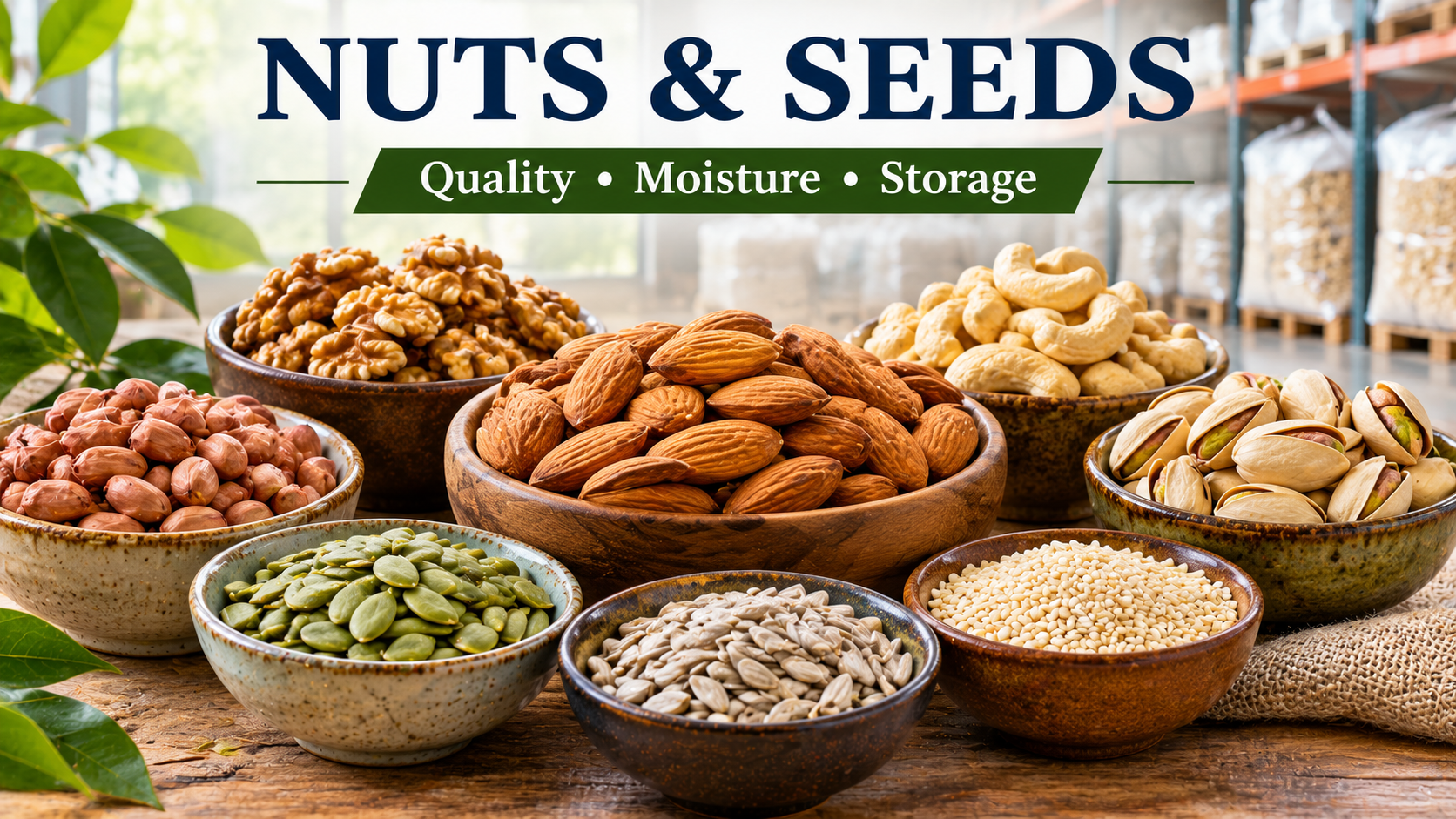
Nuts and seeds quality is an important consideration for food manufacturers, distributors, retailers, and international buyers. Products such as cashews, almonds, peanuts, walnuts, sesame seeds, and sunflower seeds have different physical characteristics, moisture requirements, and storage needs.
A product that looks attractive may still require additional quality evaluation. Understanding moisture, freshness, rancidity, packaging, and storage conditions helps buyers select products that meet their intended applications.
Nuts and Seeds Quality: Key Characteristics
Quality evaluation begins with identifying the product type, variety, processing condition, and expected specifications.
Important characteristics include:
- Appearance: Natural color, shape, and surface condition.
- Size and grading: Kernel size, uniformity, and acceptable tolerances.
- Defects: Broken kernels, damaged seeds, discoloration, and foreign materials.
- Flavor and aroma: Characteristics appropriate to the product without undesirable odors.
- Moisture: Product-specific moisture content or water activity requirements.
- Food safety: Relevant microbiological, chemical, and allergen considerations.
Quality requirements differ between raw, roasted, shelled, unshelled, and processed products.
Buyers should establish appropriate acceptance criteria instead of assuming that every nut or seed follows the same grading standard.
Understanding Common Nuts and Seeds
Cashew Nuts and Almonds
Cashews are commonly evaluated by kernel size, color, whole-kernel percentage, and the proportion of broken pieces.
Almond quality considerations may include variety, kernel size, appearance, damage, and processing condition.
Both products require appropriate protection from moisture and unfavorable storage conditions.
Peanuts and Walnuts
Peanuts may be supplied in-shell, shelled, or processed into different forms.
Quality inspection can include kernel condition, moisture, visible defects, and relevant food safety testing.
Walnuts contain oils that can deteriorate through oxidation. Their quality is influenced by storage temperature, packaging, and exposure to oxygen.
Sesame, Pumpkin, and Sunflower Seeds
Sesame seeds may be evaluated by color, purity, size, cleanliness, and moisture requirements.
Pumpkin and sunflower seeds require attention to physical damage, foreign materials, moisture, and storage stability.
Their specifications depend on whether the product is intended for direct consumption, roasting, baking, or further food manufacturing.
Why Moisture Control Matters
Moisture management is essential for maintaining nuts and seeds quality.
Excessive moisture can increase the risk of deterioration and create conditions that favor fungal growth. Very low moisture may also adversely affect the texture of certain products.
However, moisture content and water activity are not identical.
Moisture content measures the amount of water in a product, while water activity indicates how available that water is for biological and chemical processes.
Suitable limits vary according to the product type, processing method, storage conditions, and applicable specifications.
Buyers should therefore request product-specific moisture or water activity information rather than applying one universal percentage.
Rancidity, Mold, and Food Safety
Many nuts and seeds contain substantial amounts of natural oils.
Exposure to oxygen, heat, and unsuitable storage conditions can accelerate lipid oxidation, resulting in rancid flavors and odors.
Mold contamination is another important concern.
Certain fungi can produce aflatoxins, which are food safety hazards associated with some nuts, including peanuts and selected tree nuts.
Visible appearance alone cannot establish whether a product meets applicable aflatoxin limits.
The Codex guidance on aflatoxin prevention in tree nuts emphasizes appropriate handling, drying, storage, and contamination control.
Testing and regulatory requirements should be confirmed for each product and destination market.
Packaging Considerations
Packaging helps maintain product quality by limiting exposure to unfavorable environmental conditions.
Common considerations include:
- Protection against moisture absorption.
- Suitable barriers against oxygen where needed.
- Resistance to tearing, punctures, and handling damage.
- Clean, food-appropriate packaging materials.
- Appropriate package size and net weight.
- Clear product identification and lot traceability.
Packaging options may include suitable lined cartons, sealed bags, moisture-barrier pouches, and other bulk or retail formats.
The correct choice depends on the product, storage period, transportation conditions, and buyer requirements.
Storage Conditions and Shelf Life
Nuts and seeds should be stored under clean, dry, and appropriately controlled conditions.
Temperature, relative humidity, packaging, and product form all influence storage stability.
Lower temperatures can help slow quality deterioration in many dried nuts. However, suitable storage settings vary by commodity and packaging method.
Shelled products and broken kernels may deteriorate faster than intact nuts in their shells under comparable conditions.
According to the UC Davis Postharvest Research and Extension Center, moisture control and suitable packaging are important factors in protecting nut quality during storage.
Shelf-life claims should be supported by product-specific information rather than assumed from general guidelines.
What International Buyers Should Specify
Before requesting a quotation, buyers should identify:
- Product name, type, and variety.
- Raw, roasted, shelled, or other required form.
- Size, grading, and acceptable defect levels.
- Moisture, water activity, and quality specifications.
- Required testing, allergen information, and documentation.
- Packaging format, quantity, and destination country.
These details support clearer communication and more accurate product selection.
Nuts and Seeds Sourcing with YA Corporation
YA Corporation Co., Ltd. is a Thailand-based international trading and sourcing company focused primarily on food and agricultural exports.
Nuts and seeds form one of its seven product groups, alongside spices and herb powders, fresh fruits, fresh vegetables, chilled and frozen meat, seafood and aquatic products, and other selected products.
YA Corporation operates as a trading and sourcing company rather than manufacturing the products itself.
The company can review buyer inquiries and explore suitable sourcing opportunities, subject to supplier availability, product specifications, commercial terms, and applicable requirements.
YA Corporation is also preparing to develop import activities and welcomes relevant inquiries for consideration.
Product availability, laboratory results, certifications, and supply arrangements must be confirmed with the relevant supplier.
Contact YA Corporation
International buyers interested in nuts and seeds are welcome to contact YA Corporation to discuss potential sourcing requirements.
Please provide the product type, preferred grade, quantity, moisture specifications, packaging requirements, and destination country.
YA Corporation Co., Ltd.
Email : yacorporationthailand@gmail.com , info@yacorporationthailand.com
Website: https://yacorporationthailand.com/
All product specifications, availability, pricing, documentation, and commercial arrangements are subject to supplier confirmation and mutual agreement.
Comments are closed