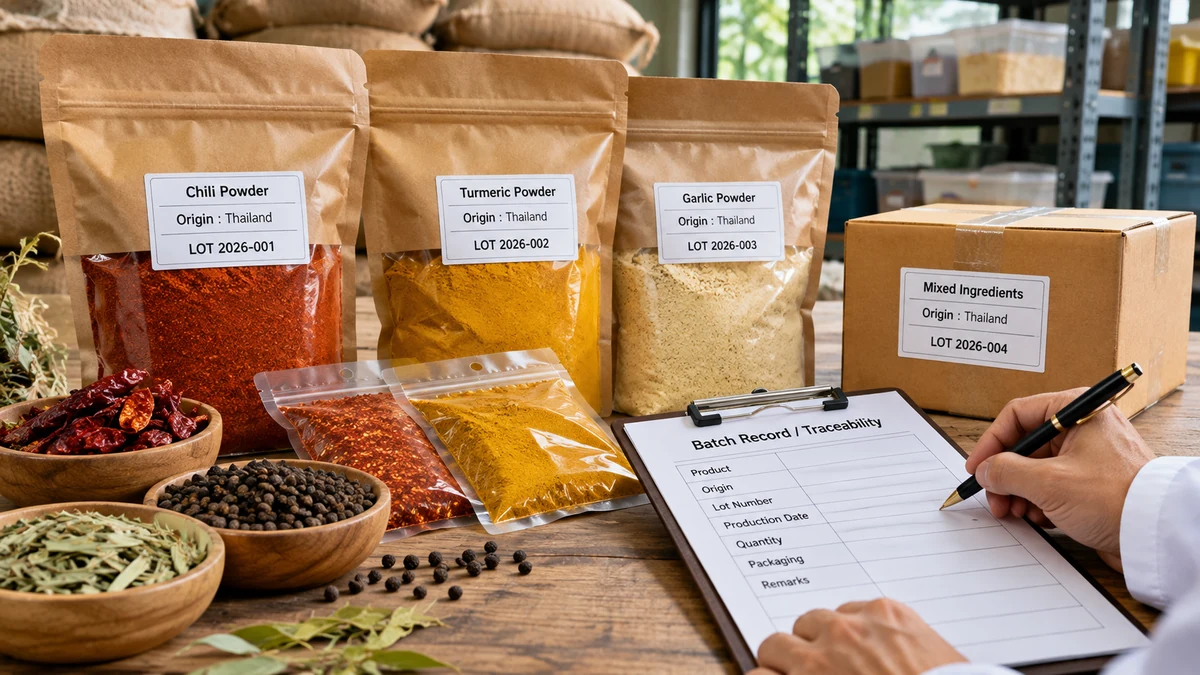
Food ingredient traceability is an important consideration for international buyers sourcing spices, seasoning powders, agricultural ingredients, and other food products.
Understanding where a product originates, how its production lots are identified, and how information is maintained throughout the supply chain can support product verification and food safety management.
For international importers, distributors, and food manufacturers, traceability information may also support inventory control, supplier communication, and the identification of affected products when quality concerns arise.
YA Corporation Co., Ltd. is a Thailand-based trading and sourcing company focusing primarily on international exports of food and agricultural products. Its main product focus includes dry spice powders, seasoning ingredients, and herb powders, alongside six other product groups.
This article explains important traceability concepts and product identification considerations for international B2B buyers.
1. What Is Food Ingredient Traceability?
Food ingredient traceability refers to the ability to follow a food product through specified stages of production, processing, and distribution.
A traceability system may connect information about raw material sources, processing activities, product identification, storage, and shipment movements.
The extent of traceability information depends on the product, supply chain, business responsibilities, and applicable regulatory requirements.
For buyers sourcing food ingredients, the goal is to understand how a product can be identified and linked to relevant supporting information.
2. Understanding Product Origin
Product origin is an important part of food sourcing information.
However, several different concepts should be distinguished:
- Raw Material Origin: Where the agricultural ingredient was grown, raised, harvested, or obtained.
- Processing Location: Where the ingredient was dried, ground, processed, packed, or otherwise prepared.
- Country of Origin: The origin determined under applicable legal or trade rules for the particular product and market.
These locations are not necessarily identical.
For example, an ingredient might be cultivated in one country and processed in another.
Buyers should avoid assuming that the location of a trading company establishes the origin of the product.
Origin declarations must be based on applicable rules and verified product information.
3. What Are Lot Numbers and Batch Numbers?
Lot numbers and batch numbers help identify particular groups of products.
Depending on the manufacturer’s system, a lot may represent products associated with a defined production, packing, or processing operation.
For illustration, a supplier might assign a code such as:
LOT-2026-001
This is a fictional example, not an actual YA Corporation product lot.
A lot number can help connect the identified product to relevant records, which may include processing dates, quality assessments, packaging information, and shipment details.
SKU vs. Lot Number
An SKU identifies a product item or variation within an inventory system.
A lot number identifies a particular group of product units associated with defined production or handling records.
For example, the same SKU for turmeric powder may be supplied in several different lots.
Each lot should remain distinguishable wherever required by applicable traceability procedures.
4. Food Ingredient Traceability for Spice Powders
Spices, seasonings, and herb powders are an important part of YA Corporation’s sourcing focus.
Examples include chili powder, turmeric powder, garlic powder, onion powder, black pepper powder, ginger powder, lemongrass powder, and galangal powder.
Traceability information may help buyers identify the relevant raw material supplier, processing establishment, packing operation, and product lot.
For example, an international buyer evaluating chili powder may request the supplier’s product identification details and applicable batch-related quality documents.
Where appropriate, a Certificate of Analysis (COA) may be associated with a particular production or testing lot.
However, a COA alone does not establish complete traceability unless the relevant product and records can be reliably linked.
For more information about sourcing spice ingredients, see Thai Spice Powder Sourcing.
5. Product Identification and Packaging Labels
Clear product identification helps buyers distinguish between ingredients, specifications, and packaging variations.
Depending on the product and destination-market requirements, identification information may include:
- Product name and description
- SKU or product reference
- Lot or batch number
- Net weight and package quantity
- Relevant production or packing dates
- Supplier or manufacturer identification
- Origin information, where applicable
- Storage instructions
The required information and its location may differ between packaging labels and accompanying records.
A barcode or QR code may support information retrieval, but the code itself does not prove that the underlying information is accurate.
6. Traceability Across Seven Product Groups
Different food products require different traceability considerations.
Fresh Fruits: Records may connect a product to its growing or packing source, variety, packing operation, and relevant lot information.
Fresh Vegetables: Identification may relate to the farm or producer, packing location, product type, and relevant handling records.
Nuts and Seeds: Traceability may involve raw material sourcing, processing, storage, and packaging batches.
Spices, Seasonings, and Herb Powders: Records may connect raw ingredients, processing activities, product specifications, and finished product lots.
Chilled and Frozen Meat: Identification may require information relating to approved establishments, product batches, processing, and temperature-controlled handling.
Fresh, Chilled, and Frozen Seafood: Traceability may involve harvest or production sources, species identification, processing establishments, and relevant shipment records.
Other Products: Identification and traceability requirements depend on the specific product and applicable regulations.
Not every product group is subject to identical recordkeeping or labeling requirements.
7. Traceability Documents and Supporting Records
Depending on the transaction, product, and regulatory requirements, buyers may review documents such as product specifications, packing lists, invoices, batch records, and quality reports.
Where relevant, production records and shipment information should be linked to the correct product and lot.
The U.S. Food and Drug Administration’s Traceability Lot Code guidance explains how traceability lot codes can support the tracking of certain foods.
The FDA Food Traceability Rule applies to specified foods and covered activities, subject to applicable exemptions. It should not be assumed to apply identically to every ingredient or international transaction.
The GS1 Global Traceability Standard information also provides useful background on standardized traceability data.
8. Questions International Buyers Should Ask Suppliers
Before confirming a product order, buyers may ask suppliers:
- What is the product’s verified origin?
- How are product lots identified?
- Which production or packing establishment is involved?
- Can the supplier link product lots to relevant specifications?
- What quality or testing records are available?
- How are lot numbers connected to shipping documents?
- What information is available if a quality concern is identified?
The answers should be evaluated against the actual product, intended market, and agreed commercial requirements.
9. YA Corporation’s Trading and Sourcing Approach
YA Corporation Co., Ltd. operates as a trading and sourcing company rather than manufacturing the food products discussed in this article.
The company reviews product identification and traceability requirements and coordinates relevant information for purchasing decisions.
The company’s primary business direction is international exports, while suitable import-related opportunities may also be considered according to product requirements and operational readiness.
Traceability information, product origin, quality documentation, and supplier capabilities must be verified rather than assumed.
10. Contact YA Corporation Co., Ltd.
International importers, distributors, and food manufacturers interested in sourcing spices, seasoning ingredients, herb powders, or other food and agricultural products are welcome to submit their inquiries.
Please provide the product name, required specifications, estimated quantity, packaging requirements, destination country, and any necessary traceability documentation requirements.
Email : yacorporationthailand@gmail.com , info@yacorporationthailand.com
Website: https://yacorporationthailand.com/
Product origin, traceability records, batch identification, testing documents, supplier availability, and commercial arrangements are subject to supplier confirmation, applicable regulations, and mutual agreement.
Comments are closed