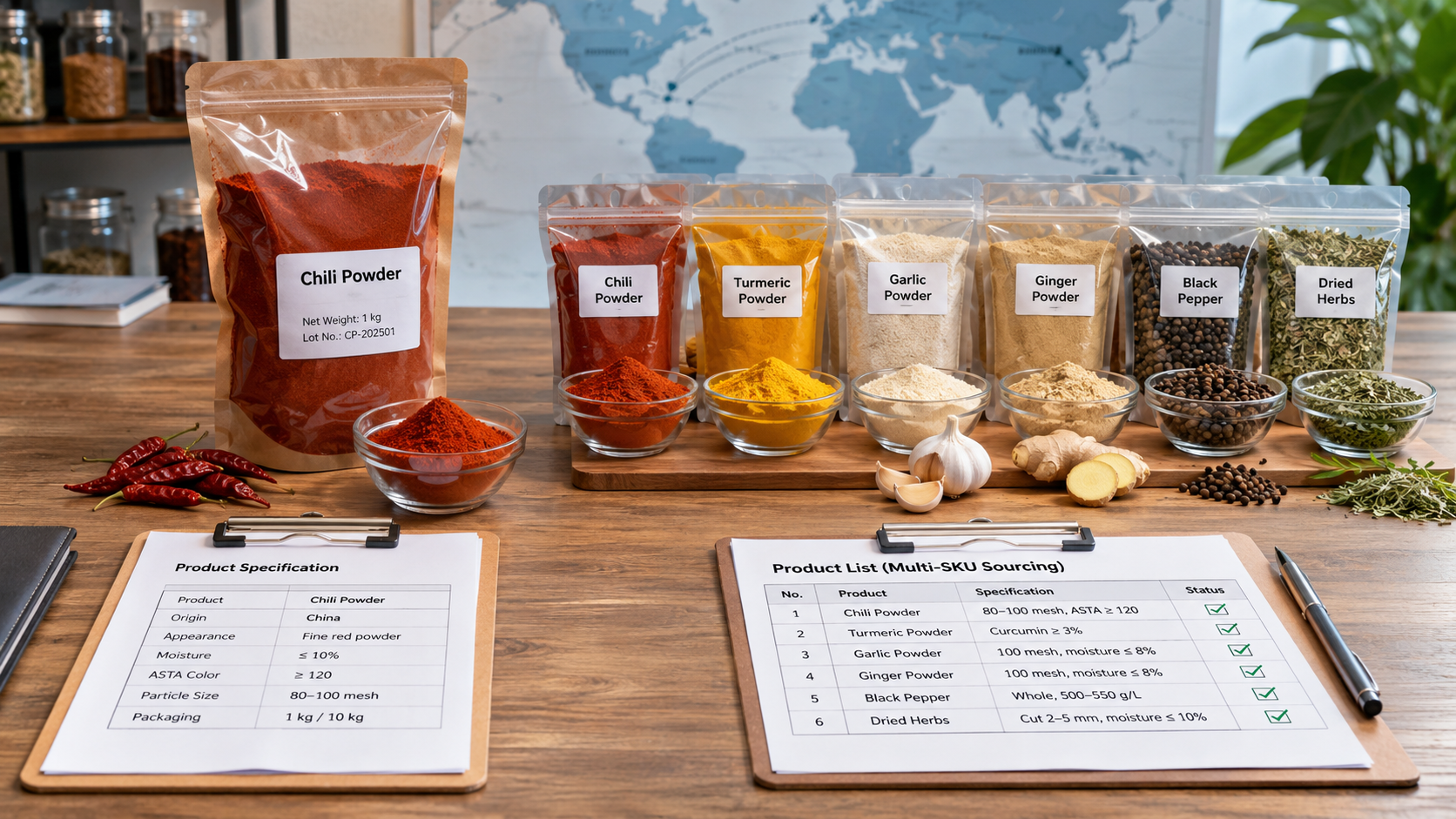
International buyers sourcing food and agricultural products may require a single ingredient or several different products within one purchasing arrangement.
Understanding the difference between single-SKU and multi-SKU sourcing helps buyers communicate product specifications, packaging requirements, quantities, and delivery expectations more clearly.
For example, one food manufacturer may need only bulk chili powder, while another buyer may require chili powder, turmeric powder, garlic powder, and dried herb ingredients.
Although both inquiries involve food ingredients, their sourcing requirements can be very different.
YA Corporation Co., Ltd. is a Thailand-based trading and sourcing company focusing primarily on international exports of food and agricultural products, particularly spices, seasoning ingredients, and herb powders.
This article explains single-SKU and multi-SKU sourcing and the important considerations for international importers, distributors, and food manufacturers.
1. What Is an SKU in Food Product Sourcing?
SKU stands for Stock Keeping Unit.
An SKU is an internal identifier used to distinguish and manage products within a business.
Depending on the company’s identification system, differences in product type, specification, packaging size, or other variations may require separate SKU codes.
For example, chili powder packed in 1 kg bags may be managed separately from chili powder packed in 25 kg bags.
An SKU is not the same as a production lot number. One SKU may include multiple production lots, each requiring appropriate identification.
International buyers should clearly identify individual product variations when preparing sourcing inquiries.
2. Understanding Single-SKU Sourcing
Single-SKU sourcing involves purchasing one defined product item or variation.
For example, a buyer may require 2,000 kg of chili powder with an agreed grind size, packaging format, and quality specification.
The inquiry focuses on one product configuration.
Key Characteristics of Single-SKU Sourcing
- One defined product item or variation
- One principal set of product specifications
- A clearly identified quantity and packaging requirement
- Supplier evaluation focused on that product
- Product-specific pricing and availability confirmation
Single-SKU sourcing may simplify product comparisons because the buyer is evaluating a defined item.
However, even one product requires appropriate verification of quality, packaging, labeling, and applicable requirements.
3. Understanding Multi-SKU Sourcing
Multi-SKU sourcing involves purchasing multiple distinct product items or variations within a sourcing arrangement.
For example, a seasoning manufacturer may request:
- 1,000 kg of chili powder
- 500 kg of turmeric powder
- 500 kg of garlic powder
- 300 kg of ginger powder
These figures are illustrative only and do not represent confirmed product availability, minimum order quantities, or commercial offers from YA Corporation.
Each ingredient may require different specifications, packaging, pricing, or supplier arrangements.
A multi-SKU inquiry does not automatically mean all products can be purchased from one supplier or shipped together.
Buyers should confirm availability and commercial feasibility for every item.
4. Comparing Single-SKU and Multi-SKU Requirements
Single-SKU and multi-SKU orders can differ across several important factors.
Product Specifications
A single-SKU order generally focuses on one defined specification.
A multi-SKU order requires each product or variation to be identified separately.
For example, chili powder may require a particular heat level and grind size, while turmeric powder may require different appearance and compositional characteristics.
Packaging Requirements
Different products may require different packaging materials or net weights.
Buyers should identify the required packaging format for each SKU rather than assuming one format is suitable for all products.
Order Quantities
A multi-SKU order should state quantities separately for every item.
Supplier minimum order quantities may apply individually and cannot automatically be combined across different products.
Quality Verification
Different products may require different testing, inspection criteria, or supporting documentation.
Product specifications and certificates should be linked to the correct items and relevant lots.
Delivery Arrangements
Multi-SKU orders may require coordination across suppliers, production schedules, and transportation arrangements.
Delivery feasibility must be evaluated before confirming commercial commitments.
5. Multi-SKU Sourcing for Spice and Herb Powders
Spices, seasonings, and herb powders are important product categories within YA Corporation’s sourcing scope.
International buyers may require combinations of chili powder, garlic powder, onion powder, turmeric powder, black pepper powder, ginger powder, lemongrass powder, and other dry ingredients.
However, each ingredient has individual characteristics.
For example, garlic powder and chili powder may require different aroma profiles, moisture specifications, particle sizes, or packaging considerations.
Combining several products into one inquiry does not eliminate the need to evaluate each ingredient separately.
For more information about ingredient sourcing, see Thai Spice Powder Sourcing.
6. Multi-SKU Sourcing Across Seven Product Groups
YA Corporation’s broader sourcing scope includes seven product groups:
- Fresh fruits
- Fresh vegetables
- Nuts and seeds
- Spices, seasonings, and herb powders
- Chilled and frozen meat
- Fresh, chilled, and frozen seafood and aquatic products
- Other products considered according to individual requirements
A buyer may inquire about multiple products within one category or across several categories.
However, different product groups can require substantially different handling conditions.
For example, dry powders and frozen seafood have different temperature, packaging, and transportation considerations.
Products requiring incompatible storage or transportation conditions should not be assumed suitable for shipment together.
The feasibility of combined sourcing and shipment arrangements must be assessed for each inquiry.
7. Quality Control and Product Traceability
Product identification and traceability are important considerations when sourcing multiple food ingredients.
Each SKU should be associated with the correct product description and specifications.
Production or supplier lot numbers should also be identifiable where applicable.
These records can help distinguish product variations and support quality reviews, stock management, and product tracing.
For guidance on product identification, buyers can consult the GS1 Glossary.
The U.S. FDA’s food traceability information also explains the role of traceability lot codes for foods covered by the relevant U.S. requirements.
The specific legal requirements depend on the product, market, and business activities involved.
8. Information Buyers Should Include in a Multi-SKU Inquiry
A well-structured inquiry helps suppliers understand the requirements for every requested item.
International buyers should consider providing:
- Product names and individual specifications
- Separate quantities for each SKU
- Preferred packaging sizes and materials
- Intended food applications
- Destination country
- Required quality documents
- Estimated purchasing schedule
- Preferred delivery arrangements
Where appropriate, buyers can organize the requested products in a table or spreadsheet.
For example, separate columns can identify the product name, grade, packaging, quantity, and special requirements.
This approach can help reduce misunderstandings when multiple product variations are involved.
9. How YA Corporation Approaches Product Sourcing
YA Corporation operates as a trading and sourcing company rather than manufacturing the products described in this article.
The company reviews buyer requirements, explores suitable sourcing options, and coordinates product and commercial information.
For multi-SKU inquiries, suitable sourcing options depend on individual product requirements, supplier availability, and operational feasibility.
The company’s primary business direction is international exports.
Suitable import-related opportunities may also be considered according to product requirements and the company’s operational readiness.
No product availability, combined shipment arrangement, supplier capability, or commercial condition should be assumed before confirmation.
10. Contact YA Corporation Co., Ltd.
International buyers interested in single-SKU or multi-SKU sourcing of spices, seasoning ingredients, herb powders, or other food and agricultural products are welcome to submit their inquiries.
Please provide your product list, required specifications, quantities, packaging requirements, and destination country.
Email : yacorporationthailand@gmail.com , info@yacorporationthailand.com
Website: https://yacorporationthailand.com/
Product sourcing, availability, pricing, quality documentation, packaging options, and commercial arrangements are subject to supplier confirmation, applicable requirements, and mutual agreement.
Comments are closed