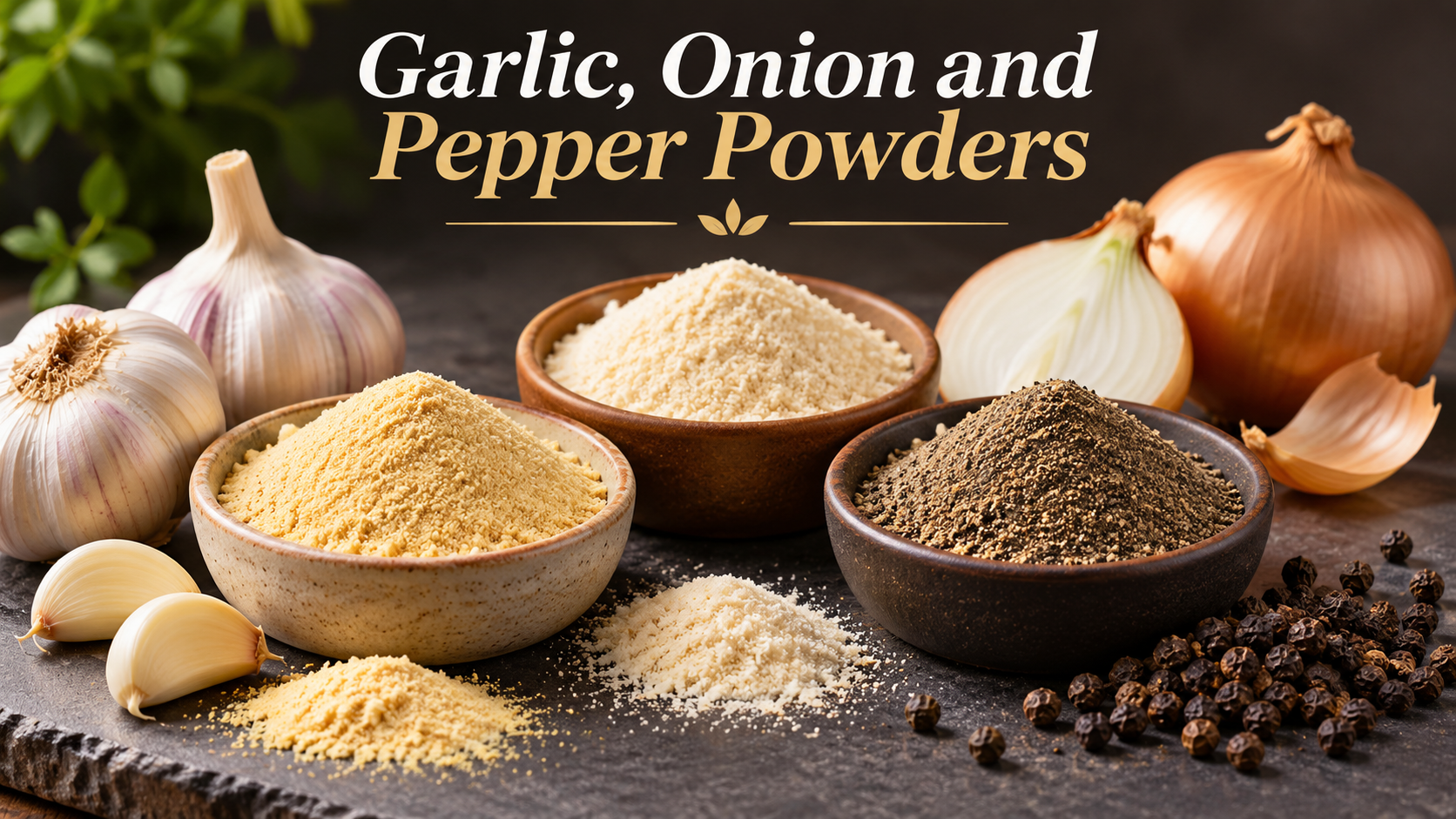
Dry seasoning ingredients are widely used in home cooking, food manufacturing, and commercial seasoning formulations. Among the common choices are garlic powder, onion powder, black pepper powder, and white pepper powder.
Although these ingredients are often combined, each contributes different flavors, aromas, and sensory characteristics to food products.
Understanding how to select suitable dry seasoning powders can help food ingredient buyers and manufacturers achieve more consistent results in their intended applications.
Understanding Garlic Powder
Garlic powder is a dried seasoning ingredient made from garlic, scientifically known as Allium sativum.
It is generally produced by preparing, drying, and grinding suitable garlic material into powder.
Flavor and Aroma Characteristics
Garlic powder provides a characteristic savory, pungent garlic flavor.
Its aroma and intensity may vary depending on the garlic variety, processing conditions, and storage environment.
Compared with fresh garlic, the powder offers a different flavor profile and is convenient for incorporation into dry food formulations.
Color and Texture
Garlic powder commonly ranges from off-white to pale cream or light yellow.
The particle size may vary from fine powder to more granular products.
Buyers should distinguish between garlic powder, granulated garlic, and garlic-containing seasoning blends because these products may have different specifications and compositions.
Understanding Onion Powder
Onion powder is produced from dried onion material, commonly derived from Allium cepa.
It is used to contribute onion flavor to foods without requiring fresh chopped onions.
Flavor and Aroma Characteristics
Onion powder contributes a characteristic onion aroma and a savory flavor that may include mild sweetness.
The intensity depends on the onion variety and processing method.
Its flavor can complement garlic powder in many seasoning formulations, but the two ingredients are not interchangeable.
Color and Texture
Onion powder may appear white, cream, pale yellow, or light beige.
Particle size and flow characteristics can vary depending on grinding and processing conditions.
Buyers should confirm whether a product is pure onion powder or a seasoning mixture containing onion and other ingredients.
Understanding Black and White Pepper Powders
Black pepper and white pepper are derived from Piper nigrum, a tropical climbing plant cultivated for its pepper berries.
Although both come from the same plant species, their processing methods produce different characteristics.
Black Pepper Powder
Black pepper is generally obtained from dried pepper berries with their outer covering retained.
After drying, the berries may be ground into powder.
Black pepper powder provides a penetrating aroma and pungent flavor. It is commonly used in savory dishes, spice blends, and food seasoning formulations.
Its appearance usually ranges from dark brown to blackish, with visible darker particles depending on the grinding process.
White Pepper Powder
White pepper is produced from pepper berries after removal of the outer covering through appropriate processing.
The resulting product typically has a pale gray, off-white, or light beige appearance.
White pepper provides characteristic pungency and aroma that differ from those of black pepper.
It may be selected for food formulations where a lighter-colored seasoning is preferred.
For reference, black and white pepper are distinct from chili peppers, which belong to the genus Capsicum.
Dry Seasoning Powders: Comparing the Main Ingredients
Each of these four ingredients provides a different seasoning function.
- Garlic powder: Characteristic pungent garlic flavor and savory aroma.
- Onion powder: Onion flavor with mild sweetness and savory notes.
- Black pepper powder: Strong pepper aroma and pungent taste.
- White pepper powder: Distinctive pepper pungency with a lighter appearance.
The best selection depends on the desired flavor, appearance, ingredient composition, and intended food product.
Combining several powders can help create a more complex seasoning profile, but the appropriate proportions should be established through product trials.
Common Culinary Applications
1. Dry Seasoning Blends
Garlic, onion, and pepper powders are frequently considered when formulating savory dry seasoning mixtures.
They can be combined with suitable ingredients such as salt, dried herbs, or other spices.
Manufacturers should evaluate ingredient proportions and flavor intensity before finalizing a formulation.
2. Meat and Poultry Seasonings
These powders may be incorporated into dry rubs or seasoning preparations for meat and poultry products.
Garlic and onion can contribute savory characteristics, while black or white pepper provides pungency.
3. Seafood Preparations
Selected garlic and pepper powders may be used in seafood seasoning mixtures.
The appropriate combination depends on the seafood type and intended flavor profile.
4. Snacks and Convenience Foods
Snack manufacturers and prepared-food producers may use these ingredients in seasoning blends for crackers, chips, noodles, and other savory products.
Consistency in grinding, aroma, and ingredient composition can be important for repeatable product formulations.
Important Quality Considerations
Commercial buyers should evaluate more than appearance and price when selecting dry seasoning ingredients.
Moisture and Powder Condition
Moisture characteristics influence powder handling and storage stability.
Excessive moisture exposure can contribute to clumping, deterioration, and other quality problems.
The acceptable moisture level should be established according to the relevant product requirements.
Flavor Consistency
Different batches may vary in aroma and intensity.
Buyers should evaluate samples and agree on suitable specifications before placing commercial orders.
Particle Size and Uniformity
Particle size can affect mixing, dispersion, and the visible appearance of a finished seasoning blend.
Fine powders and granulated products are not necessarily suitable for the same applications.
Food Safety and Ingredient Composition
Food safety evaluation may involve microbiological criteria, contaminants, foreign matter, and other applicable requirements.
Low-moisture food ingredients should not automatically be considered free from microbiological hazards.
Buyers should also confirm whether the product contains only the named ingredient or includes permitted processing aids, anti-caking agents, or other declared components.
For further reference, buyers can consult the Codex Alimentarius international food standards, including the standard for dried or dehydrated garlic.
Product-specific requirements and destination-country regulations must be checked separately.
Packaging and Storage Considerations
Dry seasoning powders should be packed in suitable food-contact packaging designed to protect against moisture and contamination.
The appropriate packaging depends on the product, required quantity, storage conditions, and intended application.
Storage in clean, dry conditions away from excessive heat, humidity, and strong odors can help preserve product characteristics.
Shelf life and recommended handling conditions should be confirmed with the supplier rather than assumed.
How Buyers Can Select Suitable Dry Seasoning Ingredients
Before requesting samples or quotations, buyers should identify their intended food application, required product type, particle size, flavor characteristics, packaging preferences, approximate quantity, and destination market.
It is also important to confirm the ingredients and additives, where applicable, and request supporting specifications or laboratory documentation when needed.
For more information about our sourcing approach, see Thai Spice Powder Sourcing: How YA Corporation Works with International Buyers.
Sourcing Dry Seasoning Powders with YA Corporation
YA Corporation Co., Ltd. is a Thailand-based international trading and sourcing company with a primary focus on exporting food and agricultural products.
Our main product interests include dry spice powders, seasoning ingredients, and herb powders, alongside six other product groups.
The company explores suitable product sourcing options based on buyer requirements and product availability.
We welcome international buyer inquiries relating to garlic powder, onion powder, black pepper powder, white pepper powder, and other dry seasoning ingredients.
Actual product availability, composition, specifications, origin, pricing, packaging, and documentation must be confirmed with the relevant supplier before any commercial commitment.
Contact YA Corporation
International buyers interested in dry seasoning ingredients are welcome to contact us with their product requirements.
Please include the product name, intended application, preferred specifications, estimated order quantity, packaging requirements, and destination country.
YA Corporation Co., Ltd.
Email : yacorporationthailand@gmail.com , info@yacorporationthailand.com
Website: https://yacorporationthailand.com/
We welcome opportunities to discuss suitable product sourcing and international trading arrangements, subject to supplier availability and applicable requirements.
Comments are closed