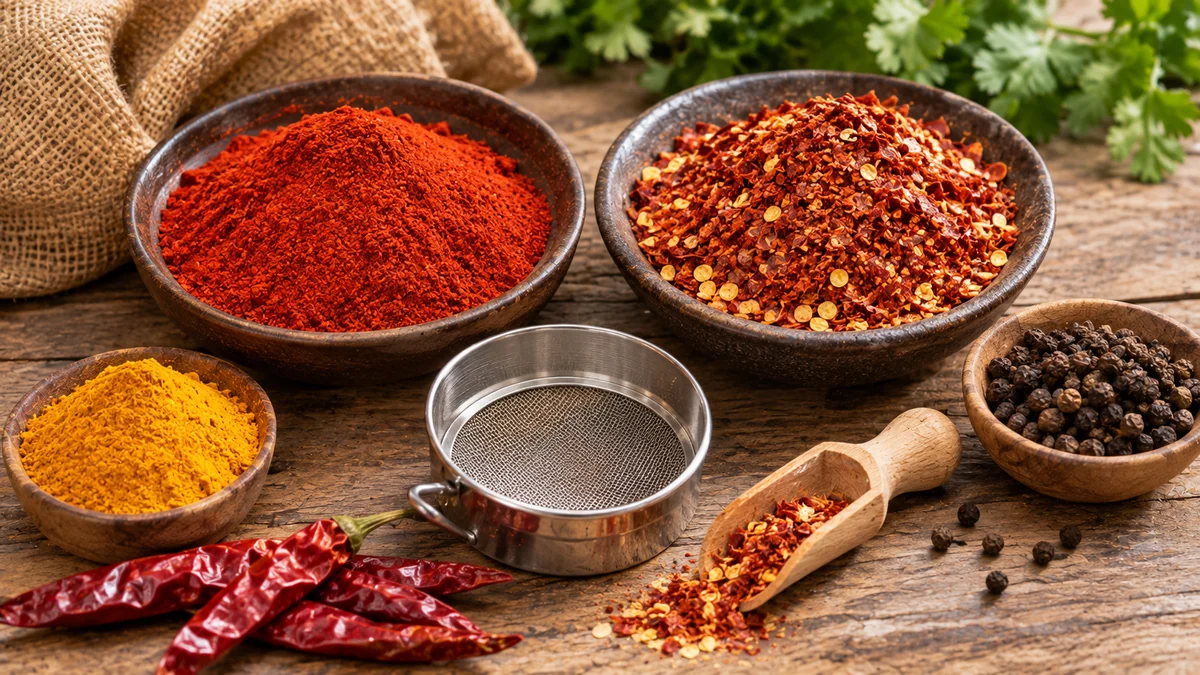
Spice powder particle size is an important characteristic affecting the appearance, texture, handling, and performance of ground spices in food applications.
Spices such as chili, turmeric, garlic, onion, ginger, coriander, cumin, and black pepper can be prepared in different grinding sizes depending on processing methods and intended uses.
Fine and coarse spice powders may differ in how they mix with other ingredients, appear in finished foods, and contribute to the overall sensory experience.
For international importers, distributors, and food manufacturers, understanding these differences helps establish clearer product specifications and sourcing requirements.
This article explains fine versus coarse grinding, common particle size considerations, and practical food applications.
1. What Is Spice Powder Particle Size?
Particle size describes the dimensions of individual particles within a ground spice product.
During grinding, dried ingredients are reduced into smaller fragments or powder.
The resulting product normally contains a range of particle sizes rather than perfectly identical particles.
This range is known as the particle size distribution.
Particle size distribution can influence product texture, powder flow, appearance, and mixing behavior.
Two products described as fine powder may therefore have different physical characteristics.
Buyers should confirm measurable specifications when particle size is important to their application.
2. Fine Grinding: Characteristics and Applications
Fine grinding produces relatively small spice particles.
Fine powders may be suitable for applications where a smoother appearance or more uniform-looking dispersion is desired.
Examples include:
- Dry seasoning blends
- Powdered soup formulations
- Bakery ingredient mixtures
- Selected snack seasonings
- Instant food seasoning preparations
Fine grinding increases the surface area of particles relative to their volume, which can influence interactions with other ingredients.
However, smaller particles do not automatically guarantee better mixing.
Powder cohesion, moisture, particle density, and differences between ingredients can also affect processing performance.
3. Coarse Grinding: Characteristics and Applications
Coarse grinding produces larger particles or fragments.
Coarse spices may provide a more visible texture and distinctive appearance in food products.
Examples include crushed chili flakes, coarse black pepper, and selected coarse-ground herb ingredients.
Coarse-ground spices may be preferred for:
- Seasoning toppings
- Dry rubs
- Selected meat preparations
- Visible spice blends
- Certain traditional culinary applications
A coarse grind can produce a different eating experience from a finely ground powder.
For example, visible chili flakes may create a different appearance and texture from finely ground chili powder.
The preferred grinding level depends on the intended food application.
4. Spice Powder Particle Size: Fine vs. Coarse Grinding
Fine and coarse grinding should be evaluated according to the product and its intended use.
Texture and Appearance
Fine particles generally create a smoother-looking powder.
Coarse particles remain more visually distinguishable and may contribute a noticeable granular texture.
Mixing Behavior
Particle size distribution influences how dry ingredients combine.
Large differences in particle size or density may contribute to segregation in some powder mixtures.
Therefore, selecting the finest available powder does not necessarily ensure the most uniform blend.
Flavor and Aroma
Grinding changes the physical surface area of spice particles and may influence aroma release and flavor perception.
However, the actual result depends on the ingredient, composition, processing conditions, and food application.
Handling Characteristics
Different particle sizes can affect powder flow, dust generation, and handling.
Fine powders may require additional attention to dust control and powder cohesion, while coarse materials may behave differently during mixing or filling.
Neither grinding type is universally superior.
5. Examples of Fine and Coarse Spice Powders
Different spices can be prepared in various particle sizes.
Chili Powder
Fine chili powder may be used in dry seasoning formulations, while crushed chili flakes can provide visible particles in toppings and culinary applications.
Chili flakes may also differ in seed content and ingredient composition, not just particle size.
Black Pepper Powder
Fine black pepper powder may be suitable for blended seasonings, whereas coarse-ground black pepper can provide a more noticeable texture.
Turmeric Powder
Turmeric is commonly used in powdered form for seasoning blends and food preparations.
Its particle size may influence dispersion and visual appearance.
Garlic and Onion Powders
Fine and coarser forms may be selected according to dry blending, seasoning, and preparation requirements.
Granulated products should not automatically be treated as identical to finely ground powders.
Ginger, Coriander, and Cumin Powders
These ingredients may be produced with different particle size distributions according to processing methods and intended applications.
All actual grinding specifications require supplier confirmation.
6. Understanding Mesh Size and Sieve Specifications
Mesh size is commonly used when describing the fineness of ground ingredients.
In sieve-based measurements, particle classification is related to the opening size of the sieve used.
A finer sieve has smaller openings than a coarser sieve.
However, a mesh number alone may not provide enough information to define a complete powder specification.
Buyers should identify the applicable sieve standard, nominal opening size, testing procedure, and the proportion of material passing or retained.
The ISO 3310-1 standard describes technical requirements for metal wire cloth test sieves.
The ISO 9276-1:2025 standard addresses the representation of particle size distribution data.
These references are useful for understanding measurement concepts, although the specific method must be suitable for the product being evaluated.
7. Particle Size and Food Ingredient Quality
Particle size is one aspect of spice powder quality, but it does not determine overall food safety.
Other important quality characteristics may include:
- Moisture content and water activity
- Product identity and composition
- Aroma and flavor characteristics
- Color and appearance
- Microbiological requirements
- Foreign matter and relevant contaminants
- Packaging and storage suitability
Research examining ground ginger has shown that particle size can also influence measured visual characteristics, including reflected light and perceived color.
Consequently, buyers should not interpret differences in appearance without considering particle size and natural ingredient variation.
A product’s physical appearance cannot replace appropriate quality documentation or laboratory verification.
8. Choosing the Right Grinding Specification
International buyers should select spice powder specifications based on intended applications rather than assuming one grind size suits every product.
A practical sourcing inquiry may include:
- Product name and botanical identity
- Fine, medium, or coarse grinding preference
- Required sieve or particle size specification
- Intended food application
- Moisture and quality requirements
- Expected order quantity
- Packaging requirements
- Destination country
Where particle size is critical, buyers may request representative samples and supporting test information.
Comparing samples under similar conditions can help determine whether a product meets the intended texture and handling requirements.
9. Spice Powder Sourcing with YA Corporation
YA Corporation Co., Ltd. is a Thailand-based trading and sourcing company focusing primarily on international exports of food and agricultural products.
Its main product focus includes dry spice powders, seasoning ingredients, and herb powders.
The company’s wider sourcing scope includes seven product groups: fresh fruits, fresh vegetables, nuts and seeds, spices and herb powders, chilled and frozen meat, fresh and frozen seafood and aquatic products, and other products considered individually.
YA Corporation operates as a trading and sourcing company rather than manufacturing the products described in this article.
The company reviews buyer requirements, explores suitable sourcing options, and coordinates product and commercial information.
International exports remain the company’s primary focus. Suitable import-related inquiries may also be considered according to product requirements and operational readiness.
Actual grinding specifications, product availability, sample options, and quality documentation must be confirmed with the relevant supplier.
10. Contact YA Corporation Co., Ltd.
International importers, food manufacturers, and distributors interested in fine or coarse spice powders are welcome to submit their product inquiries.
Please include the product name, preferred grinding size, intended food application, estimated quantity, packaging requirements, and destination country.
Email : yacorporationthailand@gmail.com , info@yacorporationthailand.com
Website: https://yacorporationthailand.com/
For more information about dry spice ingredient sourcing, read Thai Spice Powder Sourcing.
All product specifications, particle size options, supplier capabilities, sample availability, quality documents, pricing, and commercial arrangements are subject to supplier confirmation, applicable requirements, and mutual agreement.
Comments are closed